Wildlife to spot in the UK in October

October is when the garden changes pace. The summer visitors have gone, the leaves are coming down, and a lot of what is worth looking for is either out after dusk, tucked under a log, putting on one last show before winter, or migrating into our shores high above our heads (redwings from Iceland and Scandinavia are arriving now, and you are far more likely to hear them overhead at night than to see them).
This page is a guide to what I’m noticing in my own garden and on local walks, along with the stories and facts I’ve picked up on the way. I add to it through the month alongside my fortnightly newsletter, so there is more here at the end of October than at the start.
Tawny owls
You are far more likely to hear a tawny owl than see one, and October is the best month to try. Go out a couple of hours after dark on a still, overcast evening, stand near mature trees (a garden, park or churchyard will do) and listen. They call less on wet, windy or bright moonlit nights. Fortunately, the evening that’s most comfortable for us to stand around in, dry and still, is also the best one for hearing a tawny.
They are noisy at the moment because this year’s young owls are leaving home. Owls don’t share territories with their neighbours, although a pair shares its own, and the pair holds it all year round. A tawny territory is roughly 12 to 20 hectares (30 to 50 acres) depending on the habitat, which is something like 17 to 28 football pitches. That is about what it takes to feed one pair on voles, mice and small birds, so there isn’t room for last year’s chicks as well. From early autumn the adults call to warn the youngsters off, which leaves the young ones to find a patch of their own, and it is a hard time for them, because a good territory is difficult to find and many of the owls that fail to get one don’t last the winter, while those that do settle tend to stay put for life.
The famous “twit twoo” is actually two owls rather than one. The female makes the sharp “ke-wick” and the male answers with a long, wavering hoot, and when a pair call back and forth you get the sound we were all taught belongs to a single bird. Hear only one half and you are listening to an owl calling on its own. A pair usually stays together on the same patch for years, often using the same nest hole, and tawny owls can live for more than twenty years.
Tawny owls are one of five owls you can see in the UK. The others are the barn owl, little owl, long-eared owl and short-eared owl, and the little owl was brought in from the continent in the 1800s. Telling them apart is easier than it sounds. The tawny is the round-faced brown one of woods and gardens, and the only one that goes “twit twoo”. The barn owl is pale and ghostly, with a heart-shaped face, and hunts over open grassland at dusk. The little owl is small, with fierce yellow eyes, and is often seen on a fence post in daylight. The short-eared owl hunts by day over marshes and coasts, and the long-eared is a shy woodland bird with tufts on its head that are not ears.
By day they roost, well hidden, in thick branches or ivy, and the giveaway is a gang of small birds: blue tits, chaffinches and blackbirds find a sleeping owl and mob it noisily, so if you hear a commotion in a tree, look in the middle of it, where the owl is usually dozing and unbothered. If you find one, enjoy it from a distance and leave it be, because the mobbing is stress enough.
I’ve heard tawny owls in the woods behind my parents’ house, but I have only ever seen one properly. We were on a walk through the woods near where I work when we spotted a gnarly hole in the side of a tree, and my daughter wondered out loud whether it was an owl hole. Just as she said it, a tawny owl swooped down, in the middle of the day. It took my breath away, and it was so exciting to see.
Owls have a long history as omens, probably because they come out after dark, which makes them feel a bit spooky. Shakespeare wrote “tu-whit, tu-who” into a song in Love’s Labour’s Lost, and it has stuck ever since. In Julius Caesar, one of the omens Casca reports is a night bird sitting in the marketplace at noon, hooting and shrieking, so an owl out in daylight was a bad sign. And an owl seen or heard when a child was being born was a worse one. In Henry VI Part 3, King Henry tells the young Gloucester, who becomes Richard III, “The owl shriek’d at thy birth, an evil sign”. By that logic what we saw was an ill omen, although it did not feel like one at the time: it was brilliant, and a moment I won’t forget.

Pigeons
Pigeons are so easy to find that we stop looking at them, so next time you see one on the lawn, check which one it is, because Britain has more kinds than most people realise. The wood pigeon is the big one with a white patch on its neck and white bars across its wings in flight. The collared dove is paler and slimmer, with a thin black half collar. The stock dove looks like a small wood pigeon that forgot the white bits, with a dark eye and a glossy patch on its neck. Then there’s the feral pigeon, the town one, which descends from the wild rock dove.
Here’s the bit that made me rethink them. In 1995, researchers at Keio University in Japan trained pigeons to tell paintings by Monet from paintings by Picasso. The birds were rewarded with food for choosing the right artist, and they got it right more than 90% of the time. The clever part is what happened next. They could sort paintings they had never seen before, and they even grouped other artists with the right painter, so Renoir and Cezanne went with Monet while Braque and Matisse went with Picasso. Turn the Monet images upside down, though, and the birds lost the thread, which suggests they were picking out the objects in the picture rather than just memorising colours. The team won an Ig Nobel Prize for it, which seems fair.
The rest of their lives is odd too. Both parents make crop milk, a protein and fat rich liquid from the lining of the throat, and feed it to their chicks. Flamingos do something similar, which is not a sentence I expected to write. Pigeons also drink by sucking water up like a straw, where most birds scoop it and tip their heads back.
Despite being secretly quite intelligent birds, their parenting skills leave a lot to be desired, and their nest building is a good example. A wood pigeon’s nest is a loose platform of twigs, often so thin that the eggs can be seen from underneath, which makes it easy pickings for crows and magpies.
If pigeons are emptying your feeders before the little birds get a look in, our pigeon-proof feeders are built for exactly that.

Bats
October is not too late for bats. On a mild evening you can still see them until the first proper cold nights, so go out just after sunset to where trees, a hedge or a fence line meet open space, and watch the sky. You are looking for small, dark shapes flickering and zig-zagging as they chase insects. There are seventeen breeding species of bat in the UK, and the one most gardens get is the pipistrelle, which weighs between three and six grams, less than a 10p coin.
I sit out and watch ours in the evenings in the summer, and I’d worked out that they were pipistrelles. What bothered me was that I was watching something I couldn’t properly see. It was dark, they were gone in a flicker, and I had no idea what their faces looked like. So I went looking for photos, and they turned out to be quite sweet! Then I ended up down a bat rabbit hole, which taught me that there are some really strange-looking bats in the world. Some are huge and some look properly alien, and I was very grateful to live somewhere with the small, sweet-faced sort! I encountered photos of Buettikofer’s epauletted fruit bat, the giant golden-crowned flying fox, the hammer-headed bat, the eastern tube-nosed bat and the visored bat so that you don’t have to. Search for them at your own risk, or if you have the same morbid fascination as I do, you can find the ones I researched here.
Here’s the bit I didn’t know until I looked into it. Bats mate in the autumn, but the females don’t become pregnant until they wake from hibernation in the spring. They store the sperm over the winter, and each female has a single pup, usually in June, when there are plenty of insects to feed it. Badgers have a similar trick, although it works differently. A badger’s egg is fertilised soon after mating but then floats about unattached for months, and only implants around December, so the cubs arrive between January and March. In both cases the mother gets to time the birth for when the weather and the food supply suit. In the meantime the bats have a short window to feed up and put on around a third of their body weight, before they settle into a cool, sheltered spot where their heart rate, breathing and body temperature all drop. That makes a mild October evening a good chance for them to feed.
Pipistrelles were once thought to be one species and are now known to be two, the common and the soprano. They look almost identical, but they call at slightly different pitches, around 45kHz for the common and 55kHz for the soprano, which is how people tell them apart with a bat detector. The detector turns calls that are too high for us to hear into something we can, and I’ve seen the sound described as wet slaps.
If you’d like to help the bats near you, avoid insecticides, because insects are what they eat. Bats and their roosts are protected by law, so if you find one in a shed or loft, leave it alone and ask your local bat group for advice.

Money spiders
Walk along a hedge or across a field early on a still, dewy October morning and you may see it draped in fine silk, as if someone has thrown a net over it. That’s gossamer, and a lot of it comes from money spiders, the tiny dark spiders just a few millimetres long that you usually only notice when one lands on your sleeve. If one does, the old belief is that money is on its way, which is where the name comes from.
Here’s the bit I didn’t know until I looked into it. Money spiders travel by ballooning. A spider climbs to the top of a leaf or fence post, points its abdomen at the sky and lets out strands of silk, and it lifts off and drifts away. For a long time the explanation was wind, but Darwin watched hundreds of them land on the Beagle on a calm day out at sea and wondered whether something else was going on.
In 2018, researchers at the University of Bristol found the missing piece. The Earth has a natural electric field, and spiders can sense it through fine sensory hairs. When the team put money spiders in a box and switched on an electric field like the one outdoors, the spiders began to balloon, and when they switched it off while a spider was already in the air, it dropped. The field turned out to be enough to get them airborne on its own. Spiders have been recorded at altitudes of over 4,000 metres this way, and it lets them spread out and settle new ground.
So if one lands on you this month, it has probably covered more ground than any of us have all week, and it got there on an electric field.

Woodlice
One of the easiest bits of wildlife to find in a garden this month is under a flowerpot. Lift a pot, a stone or a piece of log in a damp corner, ideally on a cool morning, and you will probably find woodlice packed into the dark. They spend the day hiding from dry air and come out at night to eat dead leaves and rotting wood, which makes autumn a busy time for them. Put whatever you lifted back where it was. More than thirty species have been recorded in Britain, although most of us only ever meet a handful.
Here’s the bit I love. Woodlice have blue blood. Their blood carries oxygen using a copper-based pigment called haemocyanin, the same one crabs and lobsters use, and it is pale blue when it’s carrying oxygen and colourless when it isn’t. That’s because woodlice aren’t insects at all. They’re crustaceans, more closely related to crabs and shrimps than to beetles, and one of the few kinds that live their whole lives on land. The copper is worth keeping, so they eat their own droppings to take back what they’ve lost.
The rest of their biology is just as odd. They breathe with gill-like plates on the underside of the body, which is why they need damp, and they get rid of waste as ammonia gas through their body surface rather than as urine. Females carry their eggs, and then their young, in a fluid-filled pouch under the body, a bit like a kangaroo. The babies leave the pouch white and with only six pairs of legs, and they grow the seventh pair after their first moult. I thought all woodlice rolled into a ball like a hedgehog when they’re disturbed, but it turns out that’s just the pill woodlouse. At least one spider, the woodlouse spider, specialises in hunting them. They also feature in my children’s book, Little Moments Outside, if you have a small spotter who’d like to find them for themselves.
People say woodlice were once carried around in a small pouch on a string and swallowed as a cure for stomach ache, and I’m glad we can now just take a Rennie. In autumn some of them wander indoors looking for shelter. They’re harmless, and their presence is usually a sign of damp rather than anything dirty.

Fly agaric
If you walk past birch trees this month, look at the base of them for the classic fairy tale toadstool, a bright red cap with white spots. Fly agaric appears from late summer into early winter in woods, parks and heaths, most often under birch but also under pine and spruce. The caps can reach 20cm across, and the white spots are the remains of a veil that covered the whole thing when it was a button.
Here’s the bit I didn’t know until I looked into it. Unlike honey fungus, which attacks trees, fly agaric works with them. What you can see is only the fruiting body. Underground, its threads wrap around the tree’s roots and pass on nutrients from the soil in exchange for sugars the tree makes. Because the partnership lasts, a patch tends to come back in the same spot year after year, so if you find one you can go back and check on it.
The name is a clue to a very old use. It contains ibotenic acid, which attracts flies and kills them, and the most likely story is that pieces of the cap were broken up into saucers of milk and left out to catch them. The species name, muscaria, comes from the Latin for fly. That same chemistry is why you should never eat one. It’s poisonous, and although it rarely kills people, it can cause delirium and hallucinations, so keep dogs and children away from it.
Not everything finds it off limits. Red squirrels and slugs eat it, and fungus gnats lay their eggs in the caps so that the larvae can feed on them. Its looks have done a lot of work in stories too, from the pixie toadstools in picture books to the one the caterpillar sits on in Alice in Wonderland.
More to spot, every fortnight
I write a fortnightly newsletter with three new things to spot, a wildlife-friendly job for the garden and a piece of good eco news. My readers say they look forward to reading it over a cup of coffee on a Saturday morning, and people regularly reply to the email to let me know what they’ve seen too, which I love. If you’d like it in your inbox, add your email below.
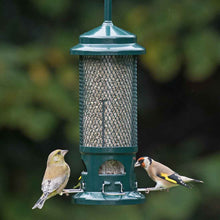
And if you’d like more daytime visitors this winter, our seasonal bird food is blended for each stage of the year, and the Little Lantern seed feeder is the one I’d pair it with.