5 things you might not know about the carrion crow

Carrion crows are often written off as scruffy scavengers, but they are among the cleverest animals in our gardens. Here are five things about them.
1. They can tell 20 dots from 30, but they don't count like we do
In an experiment at the University of Tübingen, carrion crows were shown a set of dots and had to respond only when a second set held the same number. The numbers ran from 1 to 30, and the crows were right about four times in five. But this is estimating, not counting as we do it. The dots appeared all at once, and the larger the number, the bigger the gap the crows needed to tell two sets apart, so two is easy to tell from one while 28 and 30 start to blur. Crows also recognise human and crow faces, and their brains are built very differently from ours, which suggests crows and primates evolved these abilities separately.
2. They are almost identical to the hooded crow
Genome sequencing shows that carrion and hooded crows differ in less than 0.28% of their DNA, in a small region of one chromosome. That region switches off the black pigment on the hooded crow's body, leaving it grey. The two can breed together, but almost always pick a mate that looks like themselves.
3. Last year's chicks stay to help
The female incubates three or four eggs alone for 18 to 20 days while the male feeds her, and the young fledge at around 29 to 30 days. Offspring from the previous year often stay on to help feed the new chicks instead of looking for a mate.
4. Their black is not plain black
The plumage has a green or purple sheen, much greener than a rook's gloss. A carrion crow is 48 to 52 centimetres long, compared with 63 centimetres for a raven, and weighs 400 to 600 grams. Young crows are brownish with blue eyes, which darken as they age.
5. They bow as they call
A crow's call is a deep, guttural kraa, different from any rook note. Crows also make clicking sounds, and they bow their heads with each caw.
A note on names
Corone, the second half of the scientific name Corvus corone, comes from the Greek for crow, and corvus is the Latin for raven. A flock of crows is traditionally called a murder. If you know any crow folklore, I would love to hear it.
What carrion crows like to eat, and where
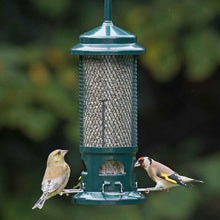
Carrion crows eat almost anything: carrion, insects, earthworms and eggs. They are clever enough to take over a feeder, so if you would like the smaller birds to get a look in, our Medusa Defender is designed to stop crows, jackdaws, magpies and pigeons reaching your hanging feeders. Fill a Little Lantern seed feeder with our seasonal bird food for the smaller birds. If you are not sure which feeder suits your garden, our feeding quiz will point you in the right direction.
Want to keep track of the carrion crows in your garden? Amidst the Birdsong: A Garden Birdwatcher's Journal is made for exactly that.
Want to read about more garden birds? See all the birds in this series.