5 things you might not know about the ring-necked parakeet

Bright green parakeets screeching through a London park are a surprising sight, but they are now a regular part of the British bird list. Here are five things about them.
1. London had three roosts of 6,000 each
In the winter of 2006, London had three separate roosts of about 6,000 parakeets each. They roost together at night and spread out across gardens and parks in the day.
2. Nobody released them on a film set
The popular stories say London's parakeets descend from pets released by Jimi Hendrix in Carnaby Street, or from birds that escaped from the set of The African Queen. A University College London study looked at more than 5,000 sighting records from 1968 to 2018, and none of the story locations stood out. A search of newspaper archives from 1804 to 2008 found not one report of an escape or release connected to the main stories. The researchers conclude the population grew from lots of small, scattered releases and escapes of pet birds, and suggest that coverage of parrot fever outbreaks in 1929 to 1931 and 1952 may have encouraged some owners to let their birds go.
3. They are accused of harming native birds, but the evidence is thinner than you would think
A Belgian study found parakeets harmed breeding nuthatches, but the BTO says no such effect has been detected in Britain. A University of St Andrews study found no evidence that parakeets significantly reduce the numbers of nuthatches or any other hole-nesting bird, though it could not rule out harm at a minority of sites where nest holes are scarce. The clearest effect is at feeders: where parakeets turn up, blue and great tits feed less and spend more time watching out. There are around 12,000 breeding pairs in Britain, and more than 30,000 birds in all.
4. They breed further north than any other parrot
The ring-necked parakeet now breeds further north than any other parrot species. Feral birds survive low winter temperatures in northern Europe, which is linked to adaptations to the cold Himalayan foothills where the species lives. Genetic work traces our birds to northern India and Pakistan, and they are mostly hybrids of two Asian subspecies. There is no evidence of African-origin birds becoming established in Britain, even though African birds were also sold as pets.
5. Both sexes can talk
Males and females can both mimic human speech, and hand-raised chicks become especially tame and ready to learn. In the wild they use their voices constantly, and a flock in a park is hard to miss.
A note on names
The genus name Psittacula comes from the Latin psittacus, meaning parrot, and the species name krameri honours the German naturalist Wilhelm Heinrich Kramer.
What ring-necked parakeets like to eat, and where
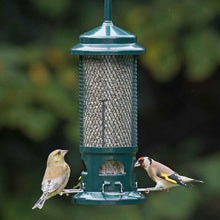
Parakeets regularly take food from bird feeders, and they are big enough to empty them. Our Starling Proof Feeder Guardian Set is designed to keep starlings and parakeets off your feeder so there is food left for the smaller birds. Fill a Little Lantern seed feeder with our seasonal bird food for the birds that stay. If you are not sure which feeder suits your garden, our feeding quiz will point you in the right direction.
Want to keep track of the ring-necked parakeets in your garden? Amidst the Birdsong: A Garden Birdwatcher's Journal is made for exactly that.
Want to read about more garden birds? See all the birds in this series.