How to clean your bird feeders

This guide has been updated in April 2026 in line with the latest guidance from the RSPB and the British Trust for Ornithology (BTO).
The first rule of bird feeding club? Clean and hygienic feeders. We all know how important it is to keep bird feeders clean and hygienic in order to avoid the spread of parasites and disease in wild bird populations.
Keeping your feeders clean is one of the most important things you can do for the birds in your garden. It always has been, but following the RSPB's updated guidance this spring, it's worth revisiting what good feeder hygiene actually looks like, and why it matters more than ever.
Trichomonosis, the disease that has driven greenfinch populations down by over 65% in three decades, spreads most easily through contaminated food and water. A single infected bird can pass the parasite on to healthy birds through regurgitated food or saliva, and a dirty feeder gives it somewhere to survive and spread. Clean feeders are not optional extras. They're the difference between your garden being a help and a hazard.
How often should I clean my feeders?
At least once a week, without fail. If you have a lot of traffic at your feeders, or the weather is particularly warm and damp, clean more frequently. The RSPB and BTO both recommend weekly cleaning as the minimum, not monthly or when it looks dirty.
What you'll need
- Waterproof gloves
- A bucket used only for feeder cleaning, never for anything else
- Hot water and washing-up liquid
- A long-handled feeder cleaning brush
- A non-toxic disinfectant such as Ark-Klens, or a mild bleach solution (5% sodium hypochlorite, diluted according to the instructions)
- A clean outdoor space to work in
Step by step
1. Do this outside, with gloves on. Never clean feeders indoors. Bird droppings and contaminated food can carry bacteria, and you don't want any of that near your kitchen.
2. Empty the feeder completely. Throw away any leftover food in an outdoor bin. Don't compost it, and don't put it back out. If there's a significant amount of uneaten food left each week, you're either putting out too much or using a food the birds in your garden aren't keen on. A good rule of thumb: fill each feeder with just a few fingers' worth of food at a time - even in a busy garden, that's all you need. The goal is for birds to empty it within a day, not for it to sit there all week. Adjust the quantity based on how quickly it disappears, and if it's not going down, try a different blend.
3. Dismantle it fully. This is the step most people skip, and it's the most important one. Every part needs to come apart easily, including the base, lid, ports, perches. Food and debris collect in crevices that even the most enthusastic cleaning will never reach. If your feeder doesn't come apart easily, it's worth considering whether it's the right feeder.
4. Scrub thoroughly with hot soapy water. Use your long-handled brush to get into every part of the feeder, removing all traces of old food, droppings, and debris. Rinse off.
5. Disinfect. Use a non-toxic disinfectant like Ark-Klens, or a mild 5% bleach solution. The BTO advises dampening surfaces with water before applying disinfectant, as dry dust can be inhaled and debris will neutralise the disinfectant and reduce its effectiveness. Apply, leave briefly, then scrub again if needed.
6. Rinse thoroughly with cold, fresh water. Every trace of disinfectant needs to come off before the feeder goes back up. Rinse each part individually.
7. Leave to dry completely before refilling. This matters. Damp food allows disease to survive and spread more easily. Don't rush this step, and leave the feeder outside to air dry fully before reassembling and refilling.
8. Wash your hands and forearms thoroughly afterwards. Even with gloves on. Keep your cleaning equipment outside and away from any food preparation areas, and never use them for anything else.
A note on feeder design
Not all feeders are equally easy to clean, and following the RSPB's updated guidance, feeder design matters more than it used to. Flat surfaces such as bird tables carry a significantly higher disease risk, because infected birds can regurgitate food onto them and healthy birds then eat it.
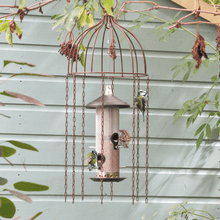
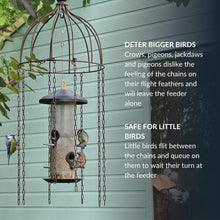
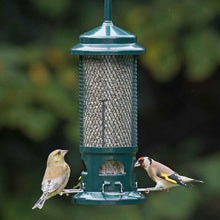
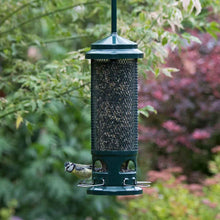
Hanging tube feeders that come apart fully for cleaning are a much safer option. I stock the Little Lantern feeder, which I use myself and is one of my favourite feeders to recommend for exactly this reason. It has no fixed perches, so the birds can land anywhere on it, which reduces the concentration of droppings in any one spot, and it dismantles completely, making the weekly clean genuinely straightforward rather than something you put off. It also has a wide brim to keep rain off the food.
Don't forget the ground beneath the feeder
Contaminated droppings, and debris collect under feeders and can spread disease just as effectively as a dirty feeder itself. Sweep or rake the area beneath your feeders each week, and move your feeder to a new spot every week if you can, to prevent build-up in one place.
What about bird baths?
Change the water daily, using fresh tap water. Clean the bath itself at least once a week using the same disinfecting approach as your feeders. If you can't commit to daily water changes, a garden pond is a lower-risk alternative, because the larger volume of water and natural ecosystem make disease transmission less likely than in a small, static bath. However, we don't all have space for a pond in the garden, and a bird bath is a good alternative if it's kept clean.
If you see a sick bird
If you spot a bird showing signs of trichomonosis (lethargy, fluffed-up feathers, food stuck around the beak, difficulty swallowing) remove your feeders immediately and don't put them back out for at least two weeks. Clean everything thoroughly before you do. You can report sick or dead birds to the Garden Wildlife Health project at gardenwildlifehealth.org, where every report helps researchers track disease in the UK.
Feeder hygiene can feel like a lot when you write it all down, but in practice it becomes second nature very quickly. A few minutes once a week, a good brush and some disinfectant, and you're doing right by the birds that visit your garden. They don't need a perfectly manicured space or an expensive setup, they just need a clean one. If you have any questions about cleaning, feeders, or anything else, you're always welcome to get in touch. That's what I'm here for.